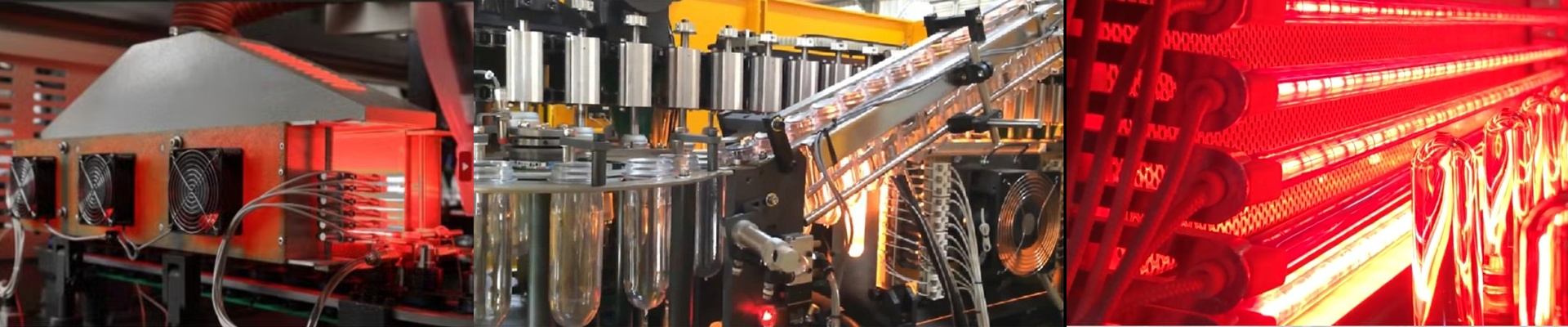
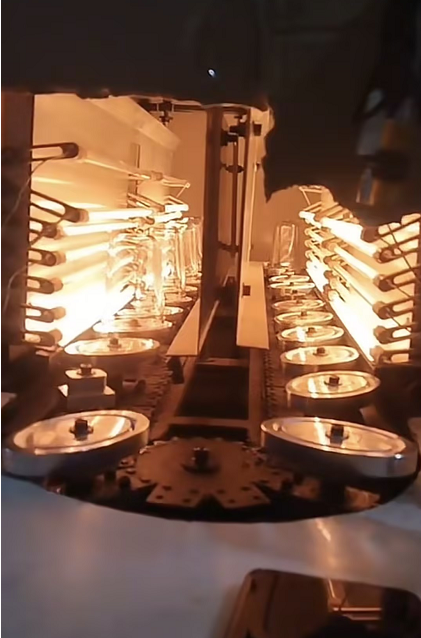
On the blow molding floor, heating drift is the kind of problem that quietly eats your margins. When the heating tunnel can’t hold preform temperature, you start seeing PET wall thickness drift, crystallization, and the line speed getting chopped to protect quality. Then you get the downtime for lamp changes on top of it. We build infrared heaters for blow molders that are engineered to match OEM heating parameters, so the process runs stable instead of reactive. What matters, technically Our emitters are short-wave infrared, so they snap to temperature with a 0.8–1.2 s warm-up to target output. You can spec quartz or halogen, both held to tight filament tolerances with stable spectral output and repeatable watt density control. Standard options cover 240 V/380 V, 1000–3000 W per lamp, with R7s or custom connectors for a direct drop-in fit into Sidel, Krones, SIPA, Husky, SACMI, and Nissei ASB heating tunnels. Dimensions and mounting match common clamp lengths and brackets, and we supply tolerance data, thermal profiles, and calibration notes so setup is repeatable. Here’s the thing about stretch blow molding: preform heating is the bottleneck. When the heat profile is right again, scrap from haze and stress marks drops, and you can hold higher line speeds without chasing the process. Energy use is tracked by zone, and in the field we’ve seen 6–12% lower heating energy compared with mismatched generic lamps. Depending on power density and duty cycle, expected service life is 5,000–8,000 hours, which stretches replacement intervals and keeps spares spend down. Installation is straightforward, but alignment is not optional. Tube position, reflector cleanliness, and preform path centering directly drive temperature uniformity. Some machines will need minor bracket tweaks to hit an exact OEM fit. If you’re running high-barrier or heat-sensitive PET grades, run a short validation to confirm the heating profile before you flip the switch to full production.